Tuesday, October 15, 2013

Citizen science at work


This was our fifth year collecting data on the Hudson River for Snapshot Day.  All the information goes to Lamont Dougherty Earth Observatory at Columbia for analysis in this DEC project involving over 70 schools from the Troy Dam to Manhattan.  The 2-3's and 6-7's take their responsibilities seriously as they measure turbidity, pH, salinity, water and tide flow, and collect sediment samples, micro-invertebrates, and other measurements of river health. 

They get the thrill of being in the field and tracking this majestic river's health over time, monitoring the effects of human and weather activity.  Citizen scientist experiences like this lend purpose and passion to the learning for Parker kids - highly motivating!


Friday, September 27, 2013

Muddy Boots Club


I had as much fun as the kids finding fall leaves and leaping frogs in Muddy Boots Club this afternoon! 

Thursday, September 26, 2013

Can children grow up without play?


You can’t teach creativity; all you can do is let it blossom, and it blossoms in play  ~ Peter Gray


Here is an interesting article about playing and how it is an essential way for children to learn about the world, themselves and others: The Play Deficit by evolutionary psychologist Peter Gray.  Through play kids learn negotiation, empathy, inginuity and other skills that have been identified as markers for success in life.

Having grown up in a time in the 50's and 60's that the author talks about as being the golden years for children's play - when childhood was completely filled with unstructured time for wandering, getting into and out of trouble, and running with a gang of mixed age neighborhood kids, maybe it is just my nostalgia that makes Gray's ideas ring true.  But watching children at Parker every day and seeing their real need  - and joy - to run, tumble, tussle, build, dig and interact with imagination, I think he and other educators and psycholigsts are on the right track.

Maybe that's why I love Planet Parker summer camp and Muddy Boots Club and why I feel so strongly that we need to carve out a place for play at school.

What are your thoughts?  What challenges do we face? 


Monday, September 23, 2013

Failure invites learning

Here is a great visual from an article called Learning and Failure by David Truss.  He says that failure can be an amazing tool for learning.

This is why risk-taking is on the list of skills in our progress reports.  By taking risks intellectually, physically and in their social lives children have the opportunity to tackle something hard where failure is a possibility.  Spending the night at Camp Chingachgook, even when they are nervous.  Going back to the drawing board 15 times to get a robot to travel in a square.  Offering an opposing opinion in a class discussion.

Because we push students to test their limits and offer "spotters" to catch them if they fall, we reinforce the "try, try again" mentality and build confidence and resilience.  I love the little poem that a math teacher taught me years ago, "Mistakes are good, they help us grow, they teach us what we need to know."

Tuesday, September 17, 2013

The 77 acre classroom


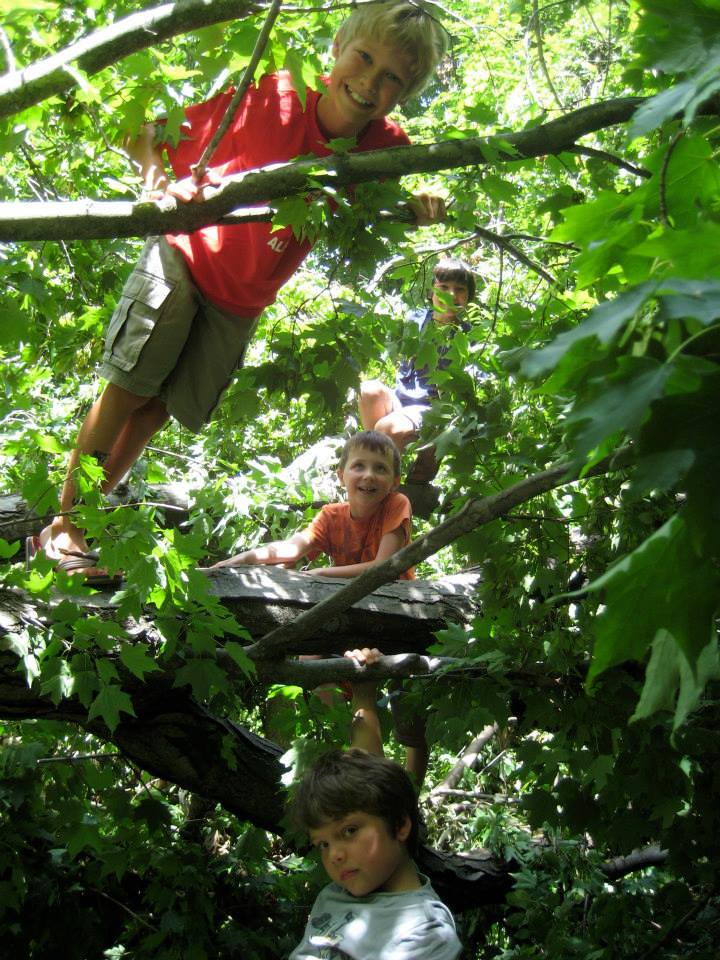
There is probably nothing at school that is cooler than going outside to find new things on a beautiful day.  How lucky we are that such beauty is in our backyard!

Friday, September 13, 2013

Breathing for mindfulness

Mindfulness, the self-managed ability to focus on the present, is a useful skill in a complex world.  As Patricia Broderick, PhD writes in her book Learning to Breathe,

Learning to channel attention to productive tasks, to sustain motivation when work becomes demanding, and to handle the frustrations of sharing, learning, and communicating with peers are skills that depend on the ability to understand and manage emotions.

As one part of our effort to help children build emotional resiliency and self control, we use mindfulness techniques with them every day.  Our faculty has worked with CS Rao, a grandparent in our school, to learn a form of breathing that allows us to quickly relax and tune out distractions.  He calls it Counting Breaths and it has the effect of feeding oxygen to the brain, calming emotions, clearing a busy mind, and giving a sense of peace and focus. 

Teachers have adapted CS's ideas for classroom practice.  In Pre K 3, a chime is rung and children  breathe smoothly and quietly as the chime sound deminishes.  In Pre K 4, students use the image of falling leaves while they breathe.  In K-1, Liliana has adopted the language "going into your silence" as children sit quietly in both mind and body and breathe slowly.  2-3's practice taking five slow clearing breaths as do the 4-5's.

This year middle school teachers are going to teach the students CS's method of using the fingers to count breaths.  As CS says, the technique can be used anytime - when you can't sleep at night, or if you are feeling anxious.  And it works!  I use it in the middle of the night when my mind is racing.

The effect with children is very positive.  They have a strategy to calm themselves that they can use anywhere.  It is a great tool for successfully negotiating frustrations, stress and anxiety and gaining attentiveness and focus.  Having the ability to be mindful gives children confidence that they can handle difficult things.  That is a gift for any individual.

You can read more in this complex and fascinating article Why Teaching Mindfulness Benefits Students' Learning, in Mind/Shift.

Thursday, August 22, 2013

What does it mean to be a STEM school?

4-5's testing the results of the solar ovens they designed and built in teams

In a recent article in MindShift, educator Anne Jolly sums up the criteria for a lesson that authentically fulfills STEM goals:

– Does it engage students in the engineering design process?
– Do students address a real-world problem?
– Do they work in teams to solve this problem?
– Are there multiple possible solutions?
– Do students get to explore and come up with ideas on their own, without being spoon-fed?

It strikes me that these criteria describe the whole learning philosophy at Parker.  If you substitute "learning" for engineering in the first point, it is a pretty exact fit for almost any project.

STEM is a hot term right now, and rightly so.  It encapsulates the idea that if we want students to become effective thinkers for the future, we need to innovate in the ways we teach them.

This list will be a great touchstone for teachers to use in assessing their plans for the year.

Thursday, July 18, 2013

Students should experiment first

At Robotics Camp, everyone is experimenting!
“We are showing that exploration, inquiry and problem solving are not just ‘nice to have’ things in classrooms. They are powerful learning mechanisms that increase performance by every measure we have.”

Research at Stanford shows that students who experiment first, before they read about a topic or watch a video, improve their learning substantially.  It's great to have proof of the importance of this sequence of presenting lessons.  Hands-on familiarity with materials gives students a context in which to organize thoughts and it deepens what they learn.


Monday, July 15, 2013

Breaking the mold

On Friday I was witness to a wild game of Spartans vs Romans as kids ran through the woods between two gigantic fallen trees with spear-like sticks in hand.  "We are the Spartans and we are on the attack!"  A fleet of running children streamed into the Roman's tree when suddenly the cry rang out "Retreat!"

The utter joy and the crazy and spontaneous changes in the direction of runners, abandoned stand-offs, and altering fortunes of both sides made for thrilling viewing.  It reminded me of days in the (distant) past when I was a kid racing through backyards with abandon in the ever evolving games of a neighborhood throng.

In reading this article in MindShift, Breaking the Mold: School Fosters Design and Discovery I remembered what I love at Parker: the freedom to make school be about discovery, excitement and fun.  These past weeks at camp, kids have built shelters, gone tearing through the woods in "Capture the Chicken", labored through many iterations of design and programming to make a LEGO robotic dog's tail wag, and designed troll huts and fairy houses by the creek.  Everyone's imagination is sparked and everyone is participating and pushing themselves in some way.

The school year has more structure for sure, but the elements of choice within a theme and freedom within the structure remain.  Learning is richly full of questioning and imagination, with skill-building layered within to give students the tools to explore further.  Learning has a distinct purpose.

Education speaker Will Richardson says "We don't need schools to be better, we need schools to be really, really different."  Camp is a great model for how different  - and how exciting - learning can be.


Tuesday, July 9, 2013

Engagement in school leads to success in life


Building and launching rockets; creating LEGO robots and programming them to flip; constructing a shelter in the woods - this is engaging learning.  It's fun!  

New research shows that children who feel interested and engaged in school show greater success professionally over and above academic attainment or socioeconomic background. I'd wager that the same holds true for engagement at camp!


Children's interest and engagement in school influences their prospects of educational and occupational success 20 years later, over and above their academic attainment and socioeconomic background, researchers have found.

Read more at: http://phys.org/news/2013-06-school-engagement-success-life.html#jCp
Children's interest and engagement in school influences their prospects of educational and occupational success 20 years later, over and above their academic attainment and socioeconomic background, researchers have found.

Read more at: http://phys.org/news/2013-06-school-engagement-success-life.html#jCp
Children's interest and engagement in school influences their prospects of educational and occupational success 20 years later, over and above their academic attainment and socioeconomic background, researchers have found.

Read more at: http://phys.org/news/2013-06-school-engagement-success-life.html#jCp