Showing posts with label the power of play in learning. Show all posts

Tuesday, January 3, 2017

A reading/running connection


There is lots of evidence that an active learning environment with time for physical activity, running and play helps children learn better.  The mind-body-learning connection is powerful stuff!  A new study from Finland shows that first grade children, especially boys, need time running around in order to learn to read.  Sitting for longer periods doesn't help - it actually hinders reading and math development!  Here is the article in Time.com : Boys Who Sit Still Have  Harder Time Learning to Read.

Boys whose days were more sedentary when they were in first grade (a crucial year for learning to read) made fewer gains in reading in second and third grade.

I'm happy to note that Parker kids in the lower grades get a minimum of 60 to 75 minutes a day for actual recess, and there is also phys ed, Muddy Boots Club, time spent outdoors just for fun, movement in music and Spanish and not a lot of "seat time".  It is a great argument for the adventure we are about to embark on -Winter Fridays - when everyone gets a change of pace for swimming, skiing, XC skiing, snow boarding, and movement.  Active body - active mind!

Tuesday, December 6, 2016

The joy of play


As an administrator, my time with kids seems to be most concentrated during recess.  I do get out and about around the school and I read to the 2-3's during lunch on Thursdays.  But recess is where I really get to see the social dynamic.

I love it.  Watching what kids choose to do with their time and how they interact is fascinating.  For the K through 5th graders, we are now playing exclusively in the woods and on the soccer field because of the Discovery Center construction.  I take to the woods with them - my favorite place.

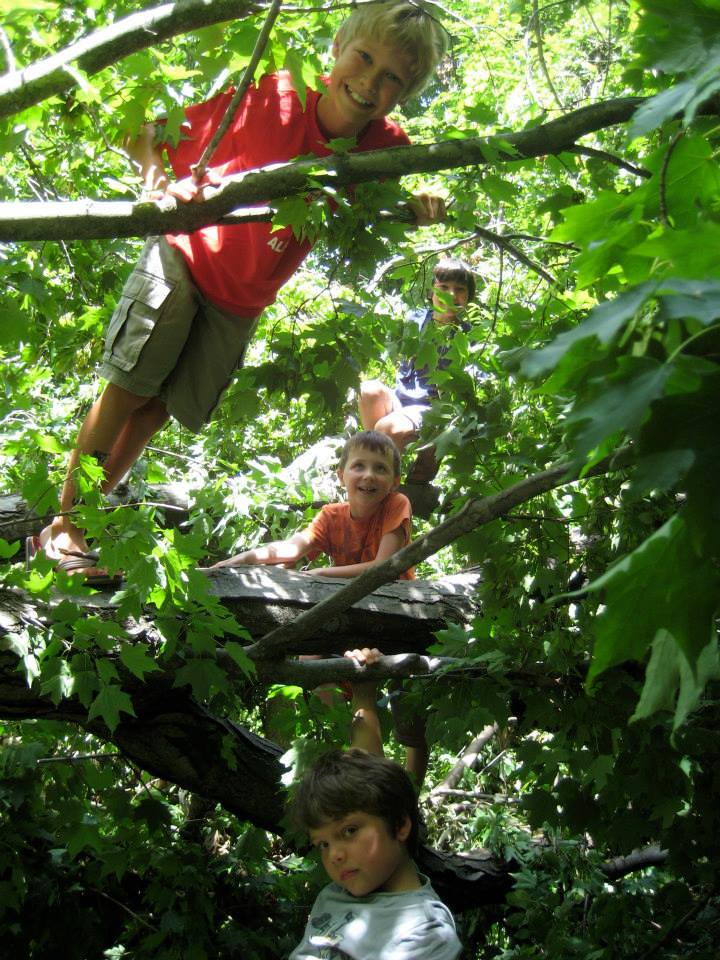
Some kids have become expert at finding salamanders - they turn over every rock and know just where to look.  Some have become expert shelter builders - and dam builders as the recent rain has filled the creek.  There are chase games, climbing games, and some children who wander  - sometimes speaking to themselves - quite engaged inside their own imaginations.  Five first grade girls practiced on Monday to put on a show - choreographed by the pavilion hill.  They ran down to stand on a picnic table bench and dance and sing Bad Blood.

The other day it snowed, and that brought a whole different way to play.  It mainly seemed to be all about eating the snow.

Children desperately need the time to create imaginative play scenarios, to run and to build things, and to negotiate conflict and rules - learning the fine points of the give and take of their social lives. Sometimes there are tears. Mostly it's pure joy!


Wednesday, February 10, 2016

Playing with questions


As the world rapidly changes, parents and educators are in a constant process of examining what skills children need for their future success.  It feels ever more important that we get it right.

Last spring, we gathered a group of scientists and college professors to pick their brains about this topic.  The skill that they felt was most important - and they were adamant about this - was the ability to ask good questions. Without a questioning mind, they asked, how can people bring passion, energy, or innovation to their work?

I just read two great articles - one about how to best educate preschoolers and the other about teaching kids how to ask questions and I think they both are spot on.

The first article is about Erika Christakis and her new book, The Importance of Being Little: What Preschoolers Really Need From Grownups.  Erika's main thesis is that play is how children learn and we desperately need to make it the centerpiece of their school and home lives.  I am so gratified that the education we  have here at Parker is steeped in rich, complex play experiences.

The second article talks about Warren Berger's book, A More Beautiful Question.  He suggests that questioning is a highly valued skill in today's innovation based work world, and is essential for an informed citizenry.  "We want children's questions to be large and expanded instead of being diminished and eventually going away," Berger says.

I was interviewed by two Parker middle school kids yesterday and we got talking about the importance of questions, play and hands-on learning.  They had terrific questions for me, and expressed how much they valued exploring through hands-on experiences as a way to learn, especially in science class.

So, check out these articles, play around with the ideas, and send me any questions you have.


Monday, November 23, 2015

Let 'em play

Play is the joyful focus of childhood - and the kind of imaginative play children do is something that fades as they move into adulthood. Can you picture a cocktail gathering of grown-ups who begin spontaneously racing all over the place chasing each other, clambering up a play structure and down the slide (over and over), and then deciding to take on roles of say, doctors with sticks as medical tools, while digging a hole in the dirt for their dead bug patients?  I love this image!

The natural developmental impulse of children to play is something that we tamper with at our own risk.  Taking it away is like taking away their tools for genius.  This recent article in the Straits Times, Let Kids Play to Help Them Succeed in Life, tells about five distinct types of play, (some of which adults still like to do): physical play, play with objects, symbolic play, pretense play, and games with rules.

The author tells about the creativity researcher George Lands who called children "genius-level divergent thinkers" who are naturals at coming up with multiple responses to problems, solutions that are highly imaginative and unrestrained.

Cultivating this natural genius seems like a good idea for educators to embrace.  For sure, giving children time for exploratory play is key.  At Parker, with a mission of inspiring curiosity and nurturing confidence, giving time and importance to play is one of the most important parts of our curriculum.

Thursday, October 22, 2015

Leave 'em smiling

A walk down to Pre K on any school day leaves me grinning from ear to ear.  Here is a glimpse of Parker Pre K at 10:15 this morning.  (For interpretation, see previous blog post...!)


How can you not smile when visiting
costumed friends hard at work in Pre K?!

How do you say popcorn in Spanish?


This is a pirate ship!

We always remember to wash our hands


Tuesday, April 14, 2015

Kids need to play


As our country has increasingly embraced the academic orientation of the educational reform movement, many children no longer have the opportunity for imaginative play, particularly after they enter kindergarten. They therefore lack the foundational skills that are linked to play: memory, emotional self-regulation, oral language and literacy, perspective-taking, and social competence.  It is these so-called “soft skills” that enable children to succeed in elementary school and beyond.  
                                                                                             ~ Laurie Levy in her blog Still Advocating

There is a reason that children love to play.  It is a natural and developmental way of learning.  Laurie Levy, founder of an innovative preschool in Chicago, writes in her article Play Needs to Follow Kids to Kindergarten, about the essential skills gained through imaginative play.  

Play is a renewing and refreshing part of the day for students of all ages.  The tinkering, social negotiating, roll-play and enjoyment  - and the choices involved in deciding what to play and with whom - are as important as the hour for math, music or reading.  Thank goodness at Parker we have the freedom and philosophy to give importance to play beyond preschool and to hold it inviolate in a fully scheduled school day.

Monday, November 3, 2014

Getting kids to sit still

I love the things that neuroscience re-teaches us.  In this great article called The right- and surprisingly wrong - ways to get children to sit still in class we learn that the ways at Parker that we get children to "sit still" are supported by science.

We have lots of recess every day.  It's outside, unless it's raining.  Kids roll down hills, explore in the woods, and are determined to master the monkey bars.  (As it turns out, running around, rolling down hills, and hanging upside down are essential activities for stimulating the inner ear - leading to development of balance.)

There's Muddy Boots Club, too, and sled-riding in winter.  We have 2,000 Steps for middle school - a time in the morning for walking and talking - recess, and an outdoor "brain break" every afternoon.

Founder of TimberNook, a nature-based development program, Angela Hanscom says, "All (that's) needed is time and practice to play with peers in the woods – in order to foster emotional, physical, and social development."

It is interesting that the things that children do naturally - rolling down hills, building giant block structures, or lying upside down on the furniture - are almost absent in traditional school settings.  By giving children time to do what they love, they can much better do what we adults need them to do (for at least a little part of the day) - sit still.

Tuesday, June 24, 2014

What is play-based learning?


When we talk about our school program as play-based it resonates with parents who want something different for their children than a testing-based school.  But I think they also get a bit nervous - is it "just play"?

Here is a great article by Katy Merrell, a school Head in Norfolk, Virginia, Pro-Active Parenting, The Power of Play-Based, Active Learning. She says, "too often the word ‘play’ makes parents apprehensive about what is taking place in the classroom, so it may help to think of it as Purposeful Learning (that is) Active (while kids are) Young (and young at heart)."

When children get the "Ah ha!" moment in a learning situation, it engages the neurotransmitters in the brain that imbed the memory.  A mind-numbing worksheet just doesn't have the same impact.  Exciting and engaging activities that pull children in, the kinds of things they view as play, are the ones that stick with them best.  Piquing and supporting children's curiosity creates optimal learning. 

For older children "playing" (exploring) with a microscope to see what's in pond water, or cutting and gluing as they figure out how to make a better wind turbine blade, feels like play - and that's what the teacher is aiming at.  Great teachers use play as the hook to help children push themselves to reach the highest of expectations.

Thursday, March 20, 2014

Kids need adventure

All right - we won't go quite as far as creating The Land as described in The Atlantic's article The Overprotected Kid.  But our Planet Parker Summer Program has elements of crazy - and that's why kids love it.  The new brochure is here.  Sign your kids up today for some old fashioned adventures!


Wednesday, December 11, 2013

What makes you happy?

K-1 teacher Liliana works with the children to create a classroom grounded in peace and friendship.  To see if the children have absorbed the lessons, she asked the kids these questions: "What do you like about school?"  and "What makes you happy?"  Here are some of their responses (categorized after the conversation by Liliana)

Peace and Beauty
  • Peace is a wonderful thing at school.  We love people.
  • In this classroom there is lots of peace and we make peace a lot.
  • We help each other in a kind way.  We get a lot of free choice.
  • We meditate.  We go into our silence.
  • You can make beautiful pictures.
Play and Friendships
  • You can make new friends and play.  We can all play together.
  • We play dress-up.
  • It's a wonderful class with all these friends.
  • Playing games at recess and I help my friends.
  • You have really good friends and you help other people.
  • We have two recesses.  We can build at recess.  We can build in the classroom and you can mix toys and then when we clean up we put them back where they belong.  If you didn't mix the toys you could not make these structures.
She noted that everyone mentioned the block center as a fun place and recess was also very popular.  They also mentioned all the projects and themes they have worked on: homes and habitats, fall, butterflies, moths, frogs and cooking.

I'm so happy that the culture of our classrooms and school community is infused with these ideas.  Our graduates carry it forth in their personal lives and to work in the peace corps, as doctors, educators, and as entrepreneurs for social causes.  The message of peace and friendship clearly resonates  - and who knows, another Nelson Mandela could be in the making.

Friday, November 1, 2013

Dramatic Play - a vehicle for learning

Pre K 3 teacher, JoAnn Bennett has been using her blog to explain the purpose behind the activities in Pre K.  Here is an excerpt from her latest entry:

Looking Deeper:  Exploration and Learning through Play

We will look deeper at Dramatic Play often over the course of this year, as it is one of the most fundamental vehicles of learning for young children. 

Within Dramatic Play, children literally "try on" roles as they seek to expand and learn about their world.  Dramatic Play utilizes and expands the children's language skills.  It is also a catalyst for cooperation, creative thinking, problem solving and sharing.  Additionally, it is often a vehicle for teaching social studies, as the children often take on the role of various community helpers within their play. 

This week as we talked about fire safety, our discussions were often reflected in the children's play.  They consistently took the information gleaned at story time and incorporated it into the scripts of their play scenarios.  On any given day in the dress up area, one was apt to hear the following exclamations, "Don't touch the stove!" or "Call 911".   The children processed and applied new information within their play, and that is indeed indicative of learning!


Thursday, September 26, 2013

Can children grow up without play?


You can’t teach creativity; all you can do is let it blossom, and it blossoms in play  ~ Peter Gray


Here is an interesting article about playing and how it is an essential way for children to learn about the world, themselves and others: The Play Deficit by evolutionary psychologist Peter Gray.  Through play kids learn negotiation, empathy, inginuity and other skills that have been identified as markers for success in life.

Having grown up in a time in the 50's and 60's that the author talks about as being the golden years for children's play - when childhood was completely filled with unstructured time for wandering, getting into and out of trouble, and running with a gang of mixed age neighborhood kids, maybe it is just my nostalgia that makes Gray's ideas ring true.  But watching children at Parker every day and seeing their real need  - and joy - to run, tumble, tussle, build, dig and interact with imagination, I think he and other educators and psycholigsts are on the right track.

Maybe that's why I love Planet Parker summer camp and Muddy Boots Club and why I feel so strongly that we need to carve out a place for play at school.

What are your thoughts?  What challenges do we face? 


Monday, July 15, 2013

Breaking the mold

On Friday I was witness to a wild game of Spartans vs Romans as kids ran through the woods between two gigantic fallen trees with spear-like sticks in hand.  "We are the Spartans and we are on the attack!"  A fleet of running children streamed into the Roman's tree when suddenly the cry rang out "Retreat!"

The utter joy and the crazy and spontaneous changes in the direction of runners, abandoned stand-offs, and altering fortunes of both sides made for thrilling viewing.  It reminded me of days in the (distant) past when I was a kid racing through backyards with abandon in the ever evolving games of a neighborhood throng.

In reading this article in MindShift, Breaking the Mold: School Fosters Design and Discovery I remembered what I love at Parker: the freedom to make school be about discovery, excitement and fun.  These past weeks at camp, kids have built shelters, gone tearing through the woods in "Capture the Chicken", labored through many iterations of design and programming to make a LEGO robotic dog's tail wag, and designed troll huts and fairy houses by the creek.  Everyone's imagination is sparked and everyone is participating and pushing themselves in some way.

The school year has more structure for sure, but the elements of choice within a theme and freedom within the structure remain.  Learning is richly full of questioning and imagination, with skill-building layered within to give students the tools to explore further.  Learning has a distinct purpose.

Education speaker Will Richardson says "We don't need schools to be better, we need schools to be really, really different."  Camp is a great model for how different  - and how exciting - learning can be.


Monday, June 3, 2013

How do we teach creativity?

Teams in K-1 designed and built bridges to support a cup of sand.

It worked!!!
The best creative works happen when we are trying to explore our world and make sense out of life. It is that sense of purpose that propels the creative process. 

So says John Spencer in Ten Things I've Learned About Creativity, a blog post in Education Re-Think.  He also says that creativity takes a lot of courage - the courage to overcome the insecurity of being wrong.

The kind of school atmosphere that Parker has, the kind that allows for re-do's, re-thinks, and do-overs as a regular part of learning is crucial for creativity to blossom.  Doing multiple drafts of a piece of writing, perseverance in LEGO Robotics, teams charged with real challenges, all these experiences accumulate to form a creative mindset. 

Spencer also says the joyful exuberance of play is often involved in creative endeavors.  You can see it in the children's faces in the photos - shared purpose, experimentation, the give and take of a small group:  it's pretty apparent how we teach creativity!

Wednesday, March 6, 2013

Move!


Moving!  It is so important for developing minds and overall health.  Here is a great article from Children and Nature Network: "Sitting is the New Smoking!"  Richard Louv says "A growing body of evidence indicates that children need far more activity, including unstructured play, to improve health, cognition and emotional well-being. Nature-based exercise appears to be especially effective."

Getting off our seats and onto our feet inside and out adds a priceless balance to our lives at Parker.  And it makes us smarter!

Monday, February 11, 2013

Entrepreneurial learning

The Global One-Room Schoolhouse: John Seely Brown (Highlights from his "Entrepreneurial Learner" Keynote at DML2012) from DML Research Hub on Vimeo.

What does it take to cultivate entrepreneurial learners?  Visiting scholar at USC and independent co-chairman of the Deloitte Center for the Edge, learning innovator, John Seely Brown ruminates on play and how to develop a questioning disposition.  This is a very cool animated video of his ideas.

At Parker we practice critique and purposeful action among other ways to get kids to "play" with ideas and explore the results - here is another way to think about it!

Thursday, October 25, 2012

Science and play

What do science and play have in common?  This wonderful TED Talk analyzes what is needed to be a good scientist.  Guess what? Curiosity, interest, innocence and zeal are key components.  The essence of what we support in our students.


Tuesday, September 4, 2012

Challenging the brain


Teachers need to explore and play, too!  During our meeting days last week, we read this article from the New York Times: Simon Says Don't Use Flashcards.  Considering the powerful effect that playing has on the developing brain, we played a rousing game of Capture-the-Chicken.

Challenging ourselves to do something new offers so many opportunities to learn.  Here is a Pre K teacher's take on how children tackle challenges, and what we can do to facilitate their learning:

Challenges can be found everywhere.  We see them when a child is trying to figure out design problems in a project, attempting a new physical feat, and testing out opinions and voices in social situations.  It can be easy for us to miss these massive opportunities for learning when we are watching our children play.  It is even easier to quickly and "expertly" solve the problem for them.

Next time your child is struggling (but not frustrated) with a task, try to stop, sit back, and watch.  See what solutions your child comes up with. If they are truly stuck, try asking them a question to draw their attention to a specific part of the issue.  Let them devise a solution.  It may not be one that you would have suggested, but their practice with personal challenges will certainly be a boon later in life.

Thursday, May 31, 2012

The tools of childhood creativity


The Five Best Toys of All Time!  This is a great article about what kids really need for creative play: sticks, boxes, string, cardboard tubes, and see if you can guess the last one...

Pre K 4 teacher Michele says:

I have great respect for the stick, especially since Muddy Boots Club. The children measure the stick, carry it along, carry things on it, whack things but not too hard, poke, drag, but never hit each other, and then discard the stick at the end of the trail.

Wednesday, April 25, 2012

Nature's good tidings


“What happens when you’re stuck inside all day? How do you feel? Compare it to how you feel if you go outside to the park or outside to play. Kids need that joy. They need those memories on an everyday basis.”

This interesting analysis about Is Outdoor Child's Play Doomed to Extinction? takes a look at several factors about children's lives.  I love the balance we have at Parker of children's free exploration outdoors and their focused study of science and the natural world. 

It reminds me of a quote from John Muir about climbing the mountains to get their good tidings:

"Nature's peace will flow into you as sunshine flows into trees.  The winds will blow their own freshness into you, and the storms their energy, while cares will drop off like autumn leaves."