Friday, November 1, 2013

Dramatic Play - a vehicle for learning

Pre K 3 teacher, JoAnn Bennett has been using her blog to explain the purpose behind the activities in Pre K.  Here is an excerpt from her latest entry:

Looking Deeper:  Exploration and Learning through Play

We will look deeper at Dramatic Play often over the course of this year, as it is one of the most fundamental vehicles of learning for young children. 

Within Dramatic Play, children literally "try on" roles as they seek to expand and learn about their world.  Dramatic Play utilizes and expands the children's language skills.  It is also a catalyst for cooperation, creative thinking, problem solving and sharing.  Additionally, it is often a vehicle for teaching social studies, as the children often take on the role of various community helpers within their play. 

This week as we talked about fire safety, our discussions were often reflected in the children's play.  They consistently took the information gleaned at story time and incorporated it into the scripts of their play scenarios.  On any given day in the dress up area, one was apt to hear the following exclamations, "Don't touch the stove!" or "Call 911".   The children processed and applied new information within their play, and that is indeed indicative of learning!


Monday, October 28, 2013

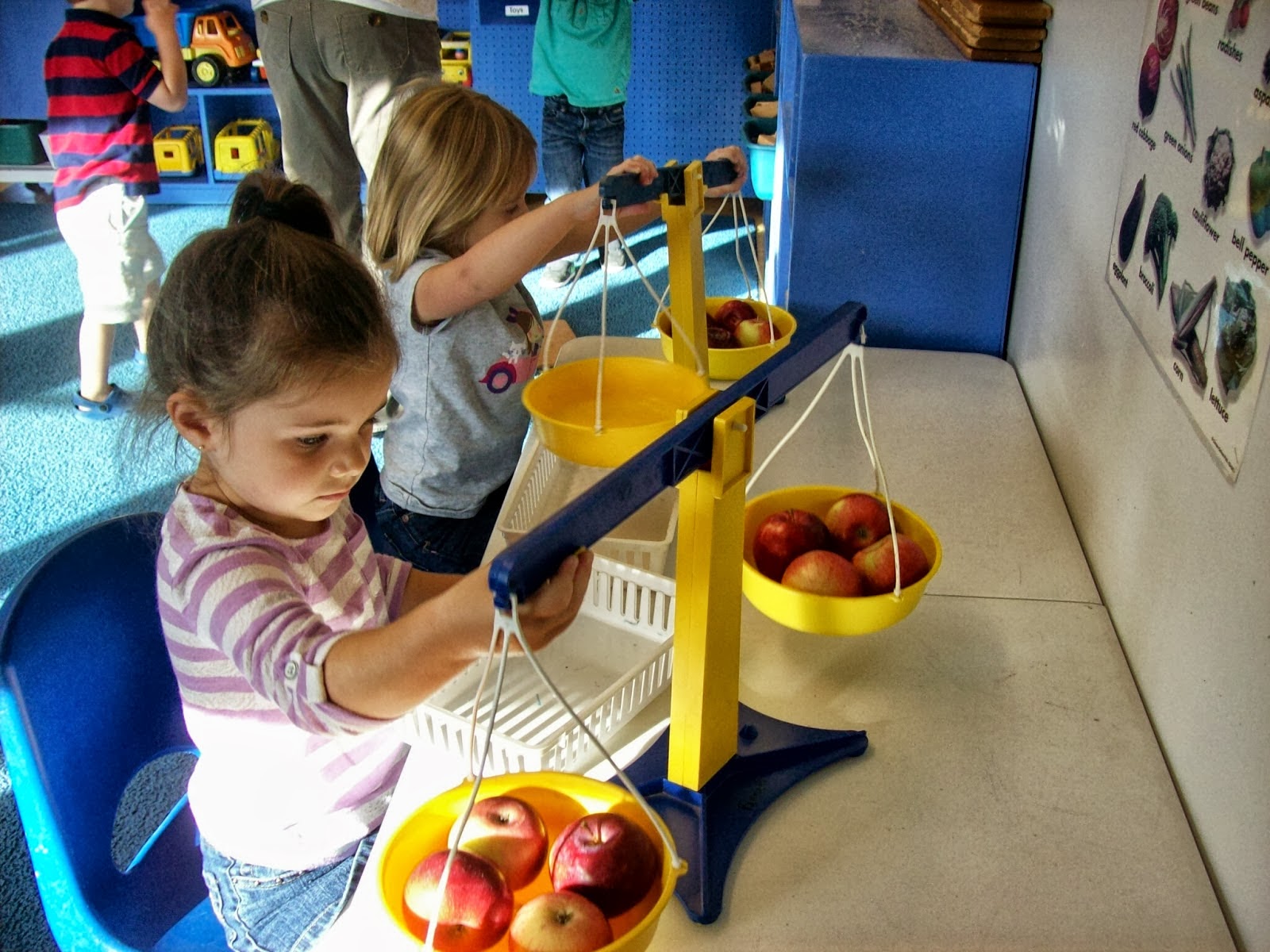
Balancing act

Here is a great article by Nicholas Carr in the Atlantic: All Can Be Lost: The Risk of Putting Our Knowledge in the Hands of Machines.  Carr talks about the tightrope we walk between letting technology do things for us and retaining the ability to become expert at doing things ourselves.

When you engage actively in a task, you set off intricate mental processes that allow you to retain more knowledge. You learn more and remember more. When you repeat the same task over a long period, your brain constructs specialized neural circuits dedicated to the activity. It assembles a rich store of information and organizes that knowledge in a way that allows you to tap into it instantaneously. Whether it’s Serena Williams on a tennis court or Magnus Carlsen at a chessboard, an expert can spot patterns, evaluate signals, and react to changing circumstances with speed and precision that can seem uncanny. What looks like instinct is hard-won skill, skill that requires exactly the kind of struggle that modern software seeks to alleviate.

As we struggle to find a balance for our kids and ourselves between the incredible positive effects of technology v.s. the myriad ways it isolates us from hands-on experience, this article provides an interesting viewpoint.  We can continue to explore together!

Wednesday, October 23, 2013

They're back!

Last night our 2013 alums came to school to share their stories of transition - to help current 8th grade students decide where they would like to go next year.  This is a cherished annual tradition - the recent alumni sit in the window seat in the library as we all gather around.

The conversation is always enlightening and makes us proud.  Parker kids just seem to blossom with confidence as they find that their skills transfer so well to new settings.  This year we had representatives from Emma Willard, Doane Stuart, Albany High, Guilderland High and Darrow.  Here are a few of their comments.

What did you find most surprising about your new school?
  • All the stairs!
  • There's not as much homework as I expected.
  • There is so much homework!
  • There are 2 tests a day!
  • 2 hours of sports a day
What did you learn at Parker that has helped you?
  • The knowledge that you are someone - don't let anyone take that away.
  • The method of thinking - I know about how to apply and connect knowledge.  The kids in my classes were taught what to think, not how to think. 
  • I understand about good research and how to cite sources.
  • Making friends.  Parker was like a close family and it was the perfect balance of support and independence.
  • I learned how to ask teachers for help.
  • I am always raising my hand because James taught us literally everything!  I am interested in learning and the kids in my classes just sit there.
  • I am definitely not fazed by being assigned an 8 page paper!
What advice can you give to the 8th graders?
  • Smile every day at someone - it makes you feel better.
  • Enjoy this year - it's the best! 
  • Try hard in all your classes.
  • Kiss Shelli's feet!  You are going to be SO well prepared for math next year.
  • Never lose sight of yourself.
  • Learn to do something that quickly relaxes you so you can relieve stress.
  • When you get to 9th grade, show that you are willing to try hard and that you are interested - then teachers will respect you.
There were other gems about making friends like "Don't be Bob Smith from Normal High  - cultivate one identifying, unique characteristic"  and "Make friends with seniors - if they like you, everyone will like you"  and "Join a Club." 

The energy and openness of our recent grads was great to see!  In big schools and small schools, public and independent - they are all doing us proud.

Alumni Update!  From 1998 to 2010 - These people are amazing! http://www.parkerschool.org/news-events/alumni-news/

Tuesday, October 22, 2013

Learn to code, code to learn

Teresa Ferrer-Mico, our former science and math teacher is teaching Parker kids programming with Scratch in Computer Club on Fridays.  It's part of the research for her doctoral dissertation - and kids are loving it.  As MIT's Mitch Resnick says in his latest TED talk, "When you learn to code, it opens up for you to learn many other things."


Tuesday, October 15, 2013

Citizen science at work


This was our fifth year collecting data on the Hudson River for Snapshot Day.  All the information goes to Lamont Dougherty Earth Observatory at Columbia for analysis in this DEC project involving over 70 schools from the Troy Dam to Manhattan.  The 2-3's and 6-7's take their responsibilities seriously as they measure turbidity, pH, salinity, water and tide flow, and collect sediment samples, micro-invertebrates, and other measurements of river health. 

They get the thrill of being in the field and tracking this majestic river's health over time, monitoring the effects of human and weather activity.  Citizen scientist experiences like this lend purpose and passion to the learning for Parker kids - highly motivating!


Friday, September 27, 2013

Muddy Boots Club


I had as much fun as the kids finding fall leaves and leaping frogs in Muddy Boots Club this afternoon! 

Thursday, September 26, 2013

Can children grow up without play?


You can’t teach creativity; all you can do is let it blossom, and it blossoms in play  ~ Peter Gray


Here is an interesting article about playing and how it is an essential way for children to learn about the world, themselves and others: The Play Deficit by evolutionary psychologist Peter Gray.  Through play kids learn negotiation, empathy, inginuity and other skills that have been identified as markers for success in life.

Having grown up in a time in the 50's and 60's that the author talks about as being the golden years for children's play - when childhood was completely filled with unstructured time for wandering, getting into and out of trouble, and running with a gang of mixed age neighborhood kids, maybe it is just my nostalgia that makes Gray's ideas ring true.  But watching children at Parker every day and seeing their real need  - and joy - to run, tumble, tussle, build, dig and interact with imagination, I think he and other educators and psycholigsts are on the right track.

Maybe that's why I love Planet Parker summer camp and Muddy Boots Club and why I feel so strongly that we need to carve out a place for play at school.

What are your thoughts?  What challenges do we face? 


Monday, September 23, 2013

Failure invites learning

Here is a great visual from an article called Learning and Failure by David Truss.  He says that failure can be an amazing tool for learning.

This is why risk-taking is on the list of skills in our progress reports.  By taking risks intellectually, physically and in their social lives children have the opportunity to tackle something hard where failure is a possibility.  Spending the night at Camp Chingachgook, even when they are nervous.  Going back to the drawing board 15 times to get a robot to travel in a square.  Offering an opposing opinion in a class discussion.

Because we push students to test their limits and offer "spotters" to catch them if they fall, we reinforce the "try, try again" mentality and build confidence and resilience.  I love the little poem that a math teacher taught me years ago, "Mistakes are good, they help us grow, they teach us what we need to know."

Tuesday, September 17, 2013

The 77 acre classroom


There is probably nothing at school that is cooler than going outside to find new things on a beautiful day.  How lucky we are that such beauty is in our backyard!

Friday, September 13, 2013

Breathing for mindfulness

Mindfulness, the self-managed ability to focus on the present, is a useful skill in a complex world.  As Patricia Broderick, PhD writes in her book Learning to Breathe,

Learning to channel attention to productive tasks, to sustain motivation when work becomes demanding, and to handle the frustrations of sharing, learning, and communicating with peers are skills that depend on the ability to understand and manage emotions.

As one part of our effort to help children build emotional resiliency and self control, we use mindfulness techniques with them every day.  Our faculty has worked with CS Rao, a grandparent in our school, to learn a form of breathing that allows us to quickly relax and tune out distractions.  He calls it Counting Breaths and it has the effect of feeding oxygen to the brain, calming emotions, clearing a busy mind, and giving a sense of peace and focus. 

Teachers have adapted CS's ideas for classroom practice.  In Pre K 3, a chime is rung and children  breathe smoothly and quietly as the chime sound deminishes.  In Pre K 4, students use the image of falling leaves while they breathe.  In K-1, Liliana has adopted the language "going into your silence" as children sit quietly in both mind and body and breathe slowly.  2-3's practice taking five slow clearing breaths as do the 4-5's.

This year middle school teachers are going to teach the students CS's method of using the fingers to count breaths.  As CS says, the technique can be used anytime - when you can't sleep at night, or if you are feeling anxious.  And it works!  I use it in the middle of the night when my mind is racing.

The effect with children is very positive.  They have a strategy to calm themselves that they can use anywhere.  It is a great tool for successfully negotiating frustrations, stress and anxiety and gaining attentiveness and focus.  Having the ability to be mindful gives children confidence that they can handle difficult things.  That is a gift for any individual.

You can read more in this complex and fascinating article Why Teaching Mindfulness Benefits Students' Learning, in Mind/Shift.