Monday, September 29, 2014

Bilingual education in Pre K at Parker

Being bilingual is a useful skill in a global world.  It benefits the brain, too, in ways we are just beginning to understand.  In the article Could Bilingual Education Mold Kids' Brains to Better Resist Distraction? the author explores some of the cognitive benefits of bilingualism. 

Last year at Parker we piloted a program of integrated Spanish in our preschool classes.  Spanish teacher, Erin Wallace, spent time several days a week speaking only in Spanish to our three and four-year-olds.  The program was so successful that this year we have hired Rosalba Santander, a native of Mexico and parent of two Parker alumni, to be the Spanish speaking assistant in the preschool every day.  She also is an assistant in K-1 Spanish class on Tuesday and Thursday.

Students (and teachers, too) are charmed by Rosalba's kind and gentle manner.  The little ones love to interact with her.  They seem to clearly understand what she says, and are beginning to answer in Spanish. 

Here is what Erin wrote about Integrated Spanish at Parker:


Based on research about how children acquire a second language, our Pre-K program provides:

  • Exposure to the language on a regular basis by known caregivers through a diverse variety of resources (books, songs, assembly, multiple speakers, modeling of other teachers/students learning)
  • Daily life integration through play in the language, negotiating play/feelings during class time, signs in the classroom, seeing the older students speak, quick conversations in the hall (“Hola, Erin!”)
  • Narration of activities such as cooking with the students, preparing for walks (put on your shoes, asking for help), while walking in the woods (pointing out objects, singing in Spanish, talking about the weather and what we find) 
  • Cultural integration is found in story choice, song choice, music class, talking about holidays/weather/people in Spanish speaking countries, crafts (Pinatas are a good example)
  • Parental support (many of our parents seek resources to read with students and use internet games and travel to pique interest)    
As a result of their experience in preschool, kindergarten students have developed vocabulary and grammar and are eager to speak Spanish.  They are excited to meet and sing with our Spanish visitors from St. Peter's School in October.  No doubt, we will uncover other benefits, as the research continues.

Here is a link to Erin's blog about Spanish classes at Parker: http://www.parker-spanish.blogspot.com/

Tuesday, September 23, 2014

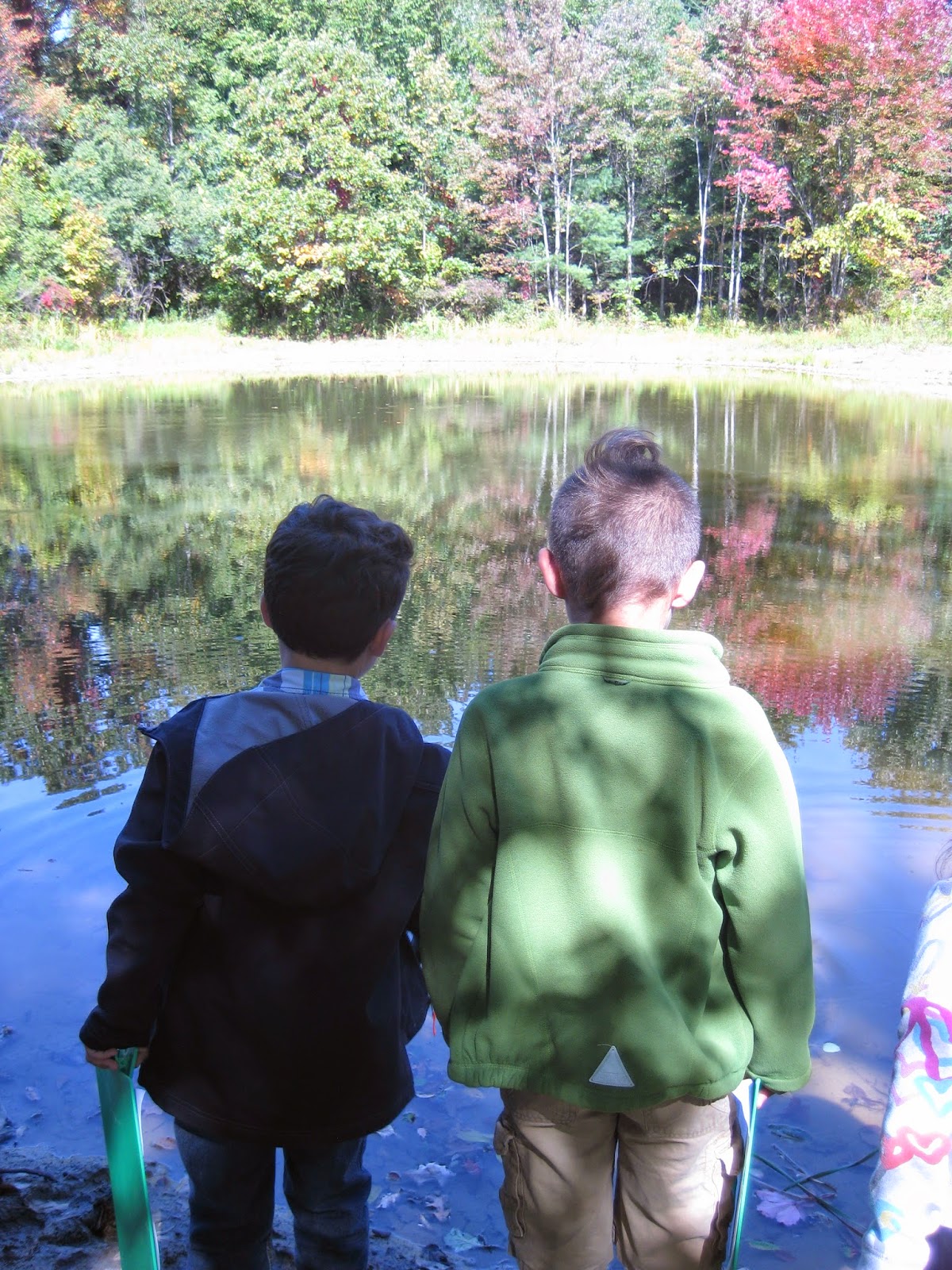
The new pond

Everyone is loving the new pond.  It has been an exciting setting for science classes in almost every grade.  Students are observing how it is evolving, what creatures it is holding, the nearby insects and plants, animal tracks...

Today a group of 2-3's led me urgently (yet quietly!) to see a brilliant green frog peering out near the shore.  What a way to hook children's interest in science and the natural world.  And to think it's all right in our back yard! 


Monday, September 22, 2014

Looking closely at detail

"Critique" is an important feature of heightening students' motivation to achieve the best they are capable of.  Here's a great article that explains why kind, specific, and useful feedback from peers is so important, How Looking at Student Work Keeps Kids and Teachers on Track. The article quotes one of our favorite educators Ron Berger, author of two books that guide us at Parker, A Culture of Quality and An Ethic of Excellence.

An important element of critique is noticing specific details.  That's another skill that students practice at Parker.  Teaching students how to observe closely - to notice details - helps them in every area of study. 


This YouTube video, Austin's Butterfly, explains the process of critique in a wonderful way.  You can see how students at any level and in any context, could use the feedback of their peers, and the ability to observe details, to produce something of excellence.


Friday, September 19, 2014

The magic learning zone

Second and third graders, a typically wiggly and talkative lot, scattered themselves across the field and crouched in quiet concentration.  Clipboard and pencil in hand, each observed and drew what was before them - goldenrod at the edge of the meadow, the fence line by the pond, the edge of the school building silhouetted against the play yard.
  
Annie Murphy Paul in this terrific article, How the Power of Interest Drives Learning analyzes what factors spark students' deep absorption in study, and how to generate and extend it.  "The feelings that characterize interest are overwhelmingly positive: a sense of being energized and invigorated, captivated and enthralled," she writes.

Interest in the topic or task puts kids into a prime learning zone.  Watch the intense concentration when they try to program a LEGO robot to pick up a ball.  They'll beg to keep going, forget lunch, and keep on trying until they've got it.

I've watched Parker students in the zone: in third grade when a student wrote his fifth essay about the industrial era in Troy, and in middle school when a group used every extra minute to perfect a Rube Goldberg contraption to pour cat food into a bowl.  I see it in their absolute fascination at the pond exclaiming over frogs and wondering about new water creatures.  Or in the preparations for a Shakespeare performance.

Designing a curriculum that sparks interest and connects learning to what's meaningful is every Parker teacher's goal. When children are interested in the task, their motivation is sky high and there is no limit to what they can accomplish.

Thursday, September 4, 2014

Catch the first day buzz...

I love the first day of school!  The eager faces, the excited buzz.  All the possibilities of the wonderful year ahead. 

At our teacher days before school started we read two articles:  How a Bigger Purpose Can Motivate Students to Learn and The Challenges and Realities of Inquiry-Based Learning.  The first reminded us that students who want to make a difference in the world are highly motivated learners.  The second reinforced that students gain social maturity when they learn in a project-based setting. 

As the teachers talked to me about their goals for the year, both of the themes emerged.  Here are a few examples:
  • 7th graders will have a weekly STEM workshop for robotics and coding, animation with Google Sketch Up, and game design with Scratch and GameMaker.
  • In middle school health class, students will organize a Health Fair to educate the broader community about making healthy decisions and living healthy lifestyles.
  • Students in all grades will practice mindfulness habits.  Linda Lantieri, author of Building Emotional Intelligence will help build teachers' skills at a workshop in December.
  • In science classes students will practice specific habits of mind such as persisting, listening with empathy, and questioning.
  • 4-5's will work on designing an improved, discovery-centered play space for the North Playground by generating ideas, conducting an interest and feasibility survey, and researching costs and funding.
And that's just a sample of what's ahead!

Friday, August 15, 2014

Parker teachers are...


The biggest strength of a school, absolutely bar none, is the quality of the teachers.  At Parker we are blessed with an outstanding faculty of dedicated, energized, compassionate and smart teachers -  masters at their craft.

Our teachers have developed a set of criteria for what excellent teaching means at Parker.  They review it each summer as they set goals for the year.  Here is a link to the document that describes what our teachers strive for.  Criteria for Excellent Teaching at Parker

Tuesday, June 24, 2014

What is play-based learning?


When we talk about our school program as play-based it resonates with parents who want something different for their children than a testing-based school.  But I think they also get a bit nervous - is it "just play"?

Here is a great article by Katy Merrell, a school Head in Norfolk, Virginia, Pro-Active Parenting, The Power of Play-Based, Active Learning. She says, "too often the word ‘play’ makes parents apprehensive about what is taking place in the classroom, so it may help to think of it as Purposeful Learning (that is) Active (while kids are) Young (and young at heart)."

When children get the "Ah ha!" moment in a learning situation, it engages the neurotransmitters in the brain that imbed the memory.  A mind-numbing worksheet just doesn't have the same impact.  Exciting and engaging activities that pull children in, the kinds of things they view as play, are the ones that stick with them best.  Piquing and supporting children's curiosity creates optimal learning. 

For older children "playing" (exploring) with a microscope to see what's in pond water, or cutting and gluing as they figure out how to make a better wind turbine blade, feels like play - and that's what the teacher is aiming at.  Great teachers use play as the hook to help children push themselves to reach the highest of expectations.

Wednesday, June 18, 2014

Show what you know


The school year culminated with many different products of children's learning, from a rocket launch to thesis presentations, essays about Hindu deities, and a Mexican hat dance.  There were videos for marketing space tourism companies and Spanish cooking shows, animated autobiographies and an online newspaper, to name just a few.

Here are links to some of the creative ways that Parker kids showed what they know.

Two seventh graders' Spanish Cooking Video: https://docs.google.com/file/d/0B3ZHSv9J8VsjNmloRWxnTUN5NlU/edit

6-7's Marketing videos to promote space tourism (part of STEM week):  https://sites.google.com/site/mathwithshelli/home/stem-week-at-parker  (I love the edginess of Sky High and Cloud Space!)

6-7's on-line news: http://parkerpurples.wordpress.com/
and   http://parkergreens.wordpress.com/

8th grade thesis presentations: http://www.ustream.tv/channel/parkerschool  password: rcp123 


Tuesday, May 27, 2014

School is a lot like summer camp


When children are interested in learning for learning's sake, you know something is going right in their schooling.  Rewarding students for taking intellectual risks helps them develop a mastery mindset, where motivation and engagement are high, and performance anxiety is low.  Kind of like summer camp.

This article in Mind Shift, What Schools Can Learn from Summer Camps hits the mark on something I like to think about: how at Parker we try to make school a lot like camp.  Camp is fun and spirited.  Kids pick things they are interested in: rockets, outdoor survival, LEGO robotics, cool chemistry, or cartooning to name just a few.  They sing together and play in the woods.  They bond with friends and counselors.  They love camp!

At its best, school is like that, too.  Exciting and interesting - a place where you can take on something you're not sure you can do.  Friendships are forged in the throes of shared experiences, working out conflicts, and when teams figure out how to work together.  Students find out that taking a risk has huge rewards, whether they are successful or not.

At Parker, we are so fortunate that the natural elements are in place: the creeks and woods, the pond and meadows.  We have developed a program that turns those features into benefits: capitalizing on the natural world to help children develop their tolerance for risk-taking, life-long curiosity and the courage and confidence to explore.

Friday, May 16, 2014

Head for the Day: Awesome: chocolate cake


We are Peyton and Jet, the Heads for the Day. The best parts of the day were chocolate cake at Alexis Diner, disco dance at Assembly, putting sticky notes all over the place, pulling the fire alarm, and handing out Popsicles to the WHOLE SCHOOL AT AN EXTRA RECESS!  Alexis Diner is really, really good! I hope we can be Head for the Day next year!!!!!!!

~ Guest Bloggers Peyton and Jet, Heads for the Day