Tuesday, June 2, 2015

Beyond Books

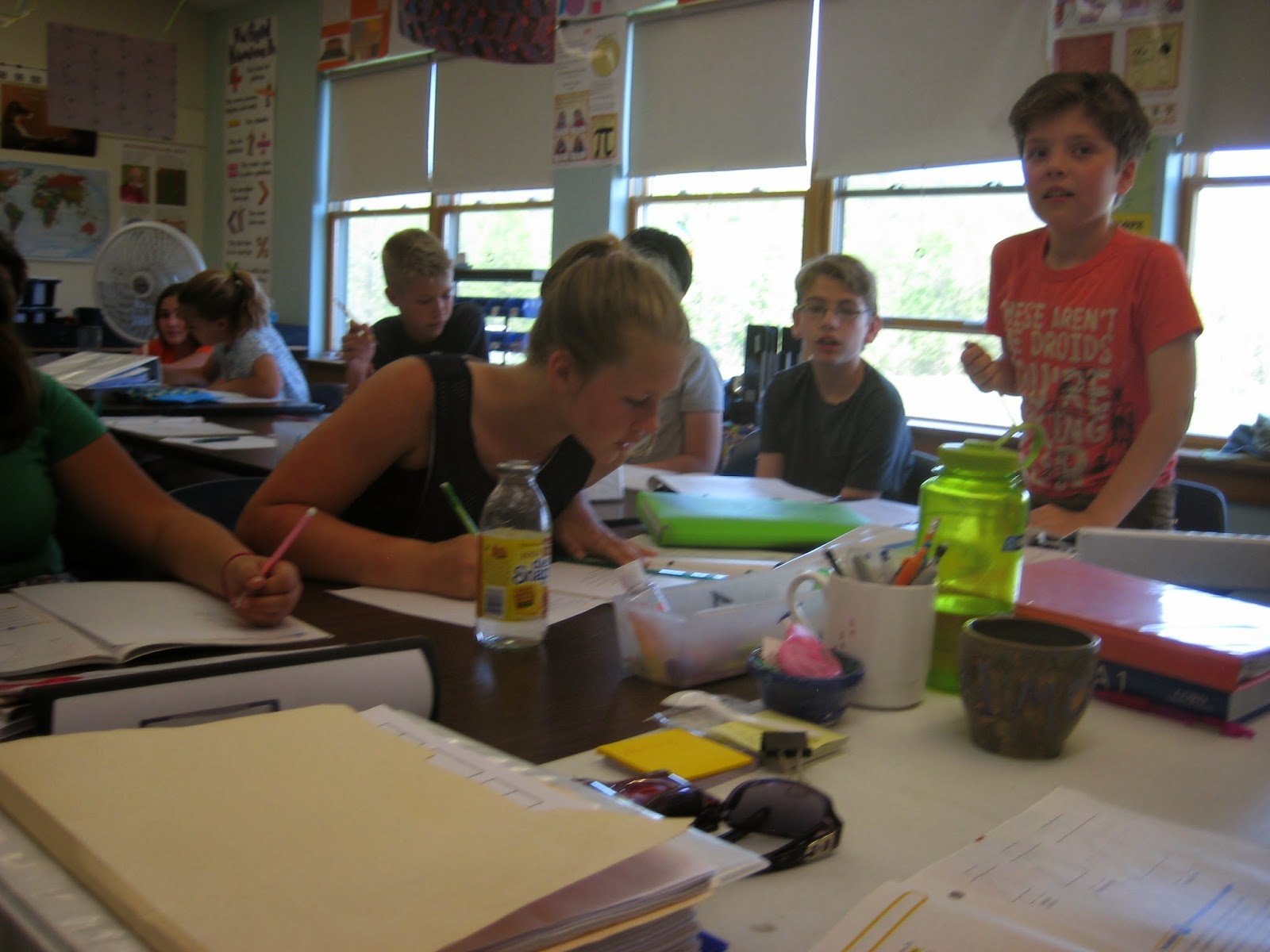
6-7's practice the presentations they will give to executives at local
fuel cell company, Plug Power.
Raising smart kids isn’t about teaching to the tests; it’s about building brainpower. Kids who can seek information, connect ideas and apply what they’ve learned aren’t just book- or school-smart – they are life-smart.       ~ Four Skills Smart Kids Need to Succeed, Metro Parent

Parker is a school filled with kids who love books.  But they don't stop there.  During the last weeks of school, we witness the multitude of ways our kids move beyond "book-smarts" to "life-smarts".
  • The 8th grade thesis presentations were passionate and poised.
  • 6-7’s STEM Week: students built hydrogen fuel cells and wrote persuasive speeches about how Plug Power should donate them to places in the world where there are humanitarian crises.  They will give the speeches on June 8 to Plug Power executives. http://www.timesunion.com/news/article/Photos-Students-present-fuel-cell-project-6314833.php#photo-8119187
  • 4-5’s had a great trip to Ellis Island. They are each taking on the persona of an immigrant to America, then writing and performing a play for their Show of Work.
  • 2-3’s are studying China: writing research essays, learning Chinese music in English and Mandarin, accompanied by our Xingtao on the hulusi (traditional Chinese instrument) and creating scroll paintings.  They will be performing a dance for the Show of Work.
  • K-1’s are studying Africa through stories, research about animals of the Savannah, weaving, song and dance.
  • Pre K classes have taken field trips to Five Rivers and are delighting in the beautiful spring weather.  Teachers prepared a slide show highlighting the rich themes they explored this year.

Tuesday, May 12, 2015

Where children yearn to be

Learning, like fire without oxygen, can suffocate without freedom.

In her Times Union editorial, Picturing Education on a Bell Curve, Kristin Christman bemoans the strictures placed around traditional schooling.  Why does school have to be the way it is?  Why can't we be more creative in how we structure school?

I have often wondered the same thing.  Does the lunch room have to be a loud place lacking in civility?  Why is there a rigid schedule that leaves out time for flexibility and play?  I recall as a child feeling like school was a long sentence stretching far into my future. Summer was the welcomed reprieve for losing myself in a book, and during my six weeks of camp in the mountains an unbelievably free time to discover what seemed far more real and important than what happened during the school year.

As progressive school educators, we have the luxurious freedom to work with like-minded colleagues to craft a school experience that puts the children first.  We can make school interesting and fun.  We can eat lunch at small tables with friendly civility.  We can take the afternoon for Muddy Boots Club or a week for tinkering with engines and planning how to do "good" in the world.  We like to ask ourselves, how can we best capture children's hearts and minds?  How can we make school the place children yearn to come?

School  - and at Parker that includes summer camp - is meant for intense friendships and self-discovery, where kids can get lost in a good book, tinker, dance, experiment and play in the woods. A place where kids learn to question and think, to hold themselves to the highest standards because it matters.

Christman has it right: To thrive, children require sleep, shelter, nutrition, fresh air, nature, athletics, play, love, family, friends, stimulation, education, community, a sense of power and purpose, and freedom to pursue their passions. Of course school should be that place where children thrive!

Friday, May 8, 2015

Guest Blogger - Head for the Day

The 6th graders made edible water bottles, and I tried one. They tasted terrible! I had a good day being Head for the day!


Friday, May 1, 2015

Why hands-on?


From planting seeds to constructing fuel cells, we engage kids in hands-on experiences.  Why is this a good way to educate?

Psychologist and education reformer John Dewey proposed that learning through experience, and not by rote, was key to children's intellectual and social development.  We see this dynamic in action as children work together to construct understanding of the world around them and determine how to ask questions and solve problems. 

The efficacy of hands-on learning is obvious: from preschoolers' exploration of growing things - to 6-7's recent STEM Week spent constructing hydrogen fuel cells and creating persuasive presentations for executives at local company Plug Power.  Through taking care of our world, from the simplest understanding of what plants need to thrive, to the nuanced and complex advocacy for how fuel cells and other forms of sustainable energy can be used in areas of humanitarian crisis, children gain a sense of agency and responsibility.

 Education becomes relevant and vital and of course, very interesting.

Friday, April 24, 2015

Celebrating Shakespeare and the Earth


We had an absolute ball on Shakespeare Night.  The  9-day artist-in-residence program with dramatist/clown Sean Fagan and his crew brings every child in the school onto the stage.  Seano works with our teachers and the kids themselves to adapt everything from a song or a storybook, to Macbeth, making a magical evening of theater.  The kids had crazy fun on stage, reveling in language, pratfall, song and plot line - and in each other's successes.

We are all a little tired today, so a buddy hike celebrating Earth Day was just the thing.


Wednesday, April 22, 2015

Can we innovate in reading and writing?

Let's take "innovation" out of science class and apply it to reading and writing.

In this great article by Nancie Atwell, winner of the $1 million Global Teacher Prize, Atwell says that the most powerful innovation in her 40 years as a middle school English teacher was giving her students time and choice as readers and writers.

That's a powerful idea in an era of textbook and test-driven solutions for education's failures, and of course it is the same philosophy we adhere to at Parker.  Read Atwell's article!  It is filled with great examples of students who tune in to their intellectual lives through developing a passion for reading and writing.

Our eighth graders are preparing the oral part of their thesis projects now, looking for ways to make a compelling presentation about an idea for which they have developed expertise.  6-7's will be preparing persuasive speeches about third world uses for hydrogen fuel cell engines after a week of building such engines.  They will deliver their impassioned talks to executives at local company Plug Power.

Reading, writing and speaking that is attached to themes, big ideas, and high-interest topics is a huge motivator for kids.  Their hunger for more drives the practice that is needed to become more skilled. Teachers don't need to wheedle, push or pull the kids along.  They can set the stage for discussion and intellectual curiosity to blossom, make DEAR (Drop Everything and Read) time a daily ritual, and stand back.  A great librarian helps, too.

Read more in 2-3 teacher Lynn Schuster's blog Here in the 2-3's or in K-1 teacher Jennifer Gresens blog posts about writing and reading.

Tuesday, April 14, 2015

Kids need to play


As our country has increasingly embraced the academic orientation of the educational reform movement, many children no longer have the opportunity for imaginative play, particularly after they enter kindergarten. They therefore lack the foundational skills that are linked to play: memory, emotional self-regulation, oral language and literacy, perspective-taking, and social competence.  It is these so-called “soft skills” that enable children to succeed in elementary school and beyond.  
                                                                                             ~ Laurie Levy in her blog Still Advocating

There is a reason that children love to play.  It is a natural and developmental way of learning.  Laurie Levy, founder of an innovative preschool in Chicago, writes in her article Play Needs to Follow Kids to Kindergarten, about the essential skills gained through imaginative play.  

Play is a renewing and refreshing part of the day for students of all ages.  The tinkering, social negotiating, roll-play and enjoyment  - and the choices involved in deciding what to play and with whom - are as important as the hour for math, music or reading.  Thank goodness at Parker we have the freedom and philosophy to give importance to play beyond preschool and to hold it inviolate in a fully scheduled school day.

Not lost in translation

This year we admitted our first student from abroad - Xingtao Liu from China. It has been an amazing year from the perspective of all of our students, our teachers, the host family, and of course, Xingtao himself.

Xingtao's grasp of English has become nuanced and deep.  He has become a full part of his host family's life and the community of the school.  Xingtao told his host parents in his Student-Led Conference that he had learned everything in more depth this year.

This morning, he was part of the Skype interview with a candidate from China for next year's 7th grade.  Xingtao and the interviewee conversed in both Mandarin and English (and then he translated for Laura, our admission director and me.)  We asked Xingtao to describe his experiences here to the student on the computer screen, which he did in lilting Chinese.  We asked him to translate what he had said.

"Chinese education and American education are different.  In China it's more about skills. Here at Parker it's more about the personality.  You learn how to be a person."

Saturday, April 11, 2015

How often do students get to do important work?


Once a student creates work of value for an authentic audience beyond the classroom -- work that is sophisticated, accurate, important and beautiful -- that student is never the same. When you have done quality work, deeper work, you know you are always capable of doing more.                           ~Ron Berger

Ron Berger is an amazing educator.  He used to teach fifth grade in Western Massachusetts, and is now Chief Program Officer at Expeditionary Learning Schools.  He wrote two books that we use as a guide for how we teach at Parker: A Culture of Quality and An Ethic of Excellence.  I love these books.  

I recommend that you read an article he wrote that is part of a series about Deeper Learning in Edutopia, Highlighting Student Work. Ron writes about the exceptional work that is possible for every student to produce.  When students have projects with an authentic purpose, that are done for real reasons and audiences beyond the teacher, they can rise to heights they didn't know were possible.  

This is what we strive for at Parker.  Stream to River in 2-3 and 6-7, the Thesis Project in 8th, and our upcoming hydrogen fuel cell project with local company Plug Power all come to mind.  When 6-7's present their persuasive arguments about energy to the executives at Plug Power, their ideas and delivery will matter.  High stakes - high expectations - high motivation - high achievement.

Wednesday, March 18, 2015

After Parker


Our alumni are amazing folks.

After Parker about half of our kids go to public schools and about half to independent schools.  95% go on to college - many to top tier schools and that's impressive.  But it is what they do with their educations that is most important.  After college their stories vary widely: from the Peace Corps to the diplomatic corps - from PhD programs to tech start-ups.

These are interesting people, committed to making a difference in the world - where ever they land.

Associate Director and art teacher, Susie Merrett, who has been at Parker since the beginning, recently sent our alumni a Facebook message, "What are you up to?"  She has had wonderful responses.

From the Parker class of 2010 to the class of 1997, below is a teaser of some of their stories. To read more about our interesting grads, CLICK HERE!

Elana Cohen ‘10: Hey Susie! I’m at Cornell and currently studying to go to medical school; right now I’m planning on a double major in English and biology with a concentration in molecular biology and a minor in fine arts. If you need anything else let me know!

Aaron Banks ‘98: Hi Susie and fellow Parker alumni, After graduating from Tufts University, I moved to Washington and worked in politics and advocacy, including on Barack Obama’s 2008 campaign and as Campaign Manager for the anti-global poverty advocacy organization ONE. In 2010, I joined the Foreign Service and have had diplomatic posting in Washington, New York, Yemen, and London, where I am now half-way through a great two year tour.

Molly Mulligan ‘97:  I finished my PhD At UMass Amherst in 2011M1 in Mechanical Engineering and moved to Israel to do my Post Doc at the Technion in Haifa. After that I was supposed to come back to the USA, but instead I got a job at a startup in Tel Aviv called SpacePharma, where I’m the director of lab technologies. My company is pretty cool, because we are working to be a low cost alternative to the space agencies around the world for doing space based research in a variety of fields including biology, medicine, material science, and agriculture. I’m really enjoying life in Israel.