Showing posts with label breathing. Show all posts

Thursday, December 3, 2015

Why is mindfulness important?

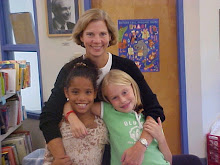
Weekly time with Buddies is one way we help children develop kindness, empathy, and caring. 
In a world where violence, discord, and disrespect are in the news on a daily basis, it is imperative that we give children (and ourselves) skills in becoming calm, kind, controlled and responsible.

To help our faculty become even more effective teachers in this area, Director of The Inner Resilience Program, Linda Lantieri, spent a day with us on Monday.  She urged the Parker faculty to continue to hold on to the courage to teach to the whole child - with compassion and collaboration front and center.

Linda gave us methods and practices that go beyond what we do with Responsive Classroom, daily calm breathing, self-reflection, and time outdoors.  To help children (and ourselves) be "in the moment," mindful and empathetic, she recommended daily activities such as building an increased vocabulary around emotions, writing gratitude journals, finding "pin-drop" moments and founding peace corners.

We know through research that children with well developed social-emotional skills do better at pretty much everything in their lives, so it behooves us to teach these skills explicitly.  Linda helped us learn a framework and techniques to build our own and our students' emotional intelligence.

Tuesday, December 2, 2014

It's all about the social stuff

I love this article about social learning by NPR's Anya Kamanetz, The Benefits of Teaching Lessons Learned in Preschool to Older Kids.  She reminds us that social learning is equal to academic learning in importance. 

In the public discourse, measuring students' success is all about testing for academic achievement.  Neuroscience research points to using additional measures, though.  The research shows that academic achievement holds little value without the social skills to communicate, self-regulate and empathize with others. "Kids who develop these skills early in life get better grades, are less susceptible to anxiety and depression and have healthier, more fulfilling relationships,” says Linda Lantieri, director of The Inner Resilience Program.

Emotional intelligence and respectful self-expression must be just as explicitly taught as problem-solving in math, or problem-finding in social studies.  As we seek academic challenges for students we can't neglect social challenges.

Programs we use at Parker like Responsive Classroom and mindfulness practices give us a common language and methods for helping children gain skills that are sometimes hard.  Second graders have an exquisite sense of fairness ("Sam budged in line - so I budged back") and sixth graders are finely attuned to social nuance ("My BFF doesn't agree with me on the project we're doing, so are we still friends?")  Helping students negotiate these choppy waters is not easy, and it takes a lot of time, but its essential.

In the block corner or at the robotics table, students need both intellectual and social skills to be successful.


Friday, December 6, 2013

Breathe

Taking moments throughout the day for breathing and reflecting adds to kids' ability to focus.  It may even be essential for them to do well in school.

Katherine Broderick, in Why Teaching Mindfulness Benefits Students' Learning in Mind Shift, says, Learning to channel attention to productive tasks, to sustain motivation when work becomes demanding, and to handle the frustrations of sharing, learning, and communicating with peers are skills that depend on the ability to understand and manage emotions. 

In preschool our students breath slowly to the diminishing sound of a chime, and in K-1, go into "their silence".  2-3's and 4-5's practice slow breaths for making transitions, and middle school students walk for 15 minutes during their daily 2000 Steps. 

In Friday Assemblies we are trying something new - five calming breaths to begin and end Assembly.  It gives everyone a moment to focus, it oxygenates the brain and prepares us to experience the present.  A wonderful skill for life success! 

Friday, September 13, 2013

Breathing for mindfulness

Mindfulness, the self-managed ability to focus on the present, is a useful skill in a complex world.  As Patricia Broderick, PhD writes in her book Learning to Breathe,

Learning to channel attention to productive tasks, to sustain motivation when work becomes demanding, and to handle the frustrations of sharing, learning, and communicating with peers are skills that depend on the ability to understand and manage emotions.

As one part of our effort to help children build emotional resiliency and self control, we use mindfulness techniques with them every day.  Our faculty has worked with CS Rao, a grandparent in our school, to learn a form of breathing that allows us to quickly relax and tune out distractions.  He calls it Counting Breaths and it has the effect of feeding oxygen to the brain, calming emotions, clearing a busy mind, and giving a sense of peace and focus. 

Teachers have adapted CS's ideas for classroom practice.  In Pre K 3, a chime is rung and children  breathe smoothly and quietly as the chime sound deminishes.  In Pre K 4, students use the image of falling leaves while they breathe.  In K-1, Liliana has adopted the language "going into your silence" as children sit quietly in both mind and body and breathe slowly.  2-3's practice taking five slow clearing breaths as do the 4-5's.

This year middle school teachers are going to teach the students CS's method of using the fingers to count breaths.  As CS says, the technique can be used anytime - when you can't sleep at night, or if you are feeling anxious.  And it works!  I use it in the middle of the night when my mind is racing.

The effect with children is very positive.  They have a strategy to calm themselves that they can use anywhere.  It is a great tool for successfully negotiating frustrations, stress and anxiety and gaining attentiveness and focus.  Having the ability to be mindful gives children confidence that they can handle difficult things.  That is a gift for any individual.

You can read more in this complex and fascinating article Why Teaching Mindfulness Benefits Students' Learning, in Mind/Shift.